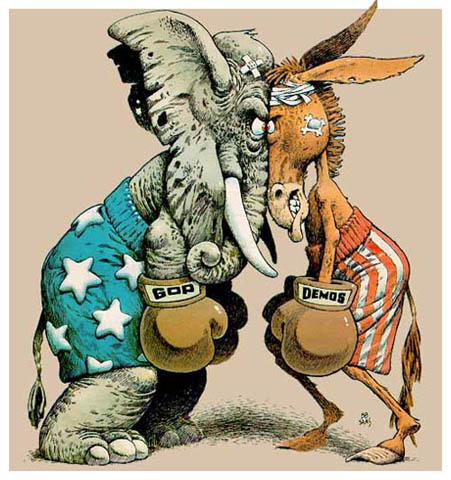
"A wise and frugal government which shall restrain men
from injuring one another, which shall leave them otherwise free to regulate their own pursuits of industry and improvement, and shall not take from the mouth of labor the bread it has earned. This is the sum of good government."
(Thomas Jefferson)


Showing posts with label Back in Black. Show all posts

Sunday, July 31, 2011

Reports of a Debt Compromise are Circulating this Morning

This article from John Podhoretz is very good of explanation of what is going on today about some of the Republicans we have in the Congress who will vote "NO" when they don't get 100% of what they want for their agenda.  I am still shocked that there are members of Congress and Tea Party leaders who actually thought we could take over the House, and we were going to bully our way into getting something passed immediately to roll back and cut the deficit when there was a Democrat Senate and a Democrat President. 

It takes two election cycles to make a real agenda change but these people are demanding it now or they will vote NO!  One of them, Bachmann wants to run for President on the Republican ticket -- we would suggest she would be better off with her mentor Ron Paul to run as Libertarians because being NO all the time is not what thinking Republicans are all about.  The best one is thinking the Balanced Budget Amendment is going to pass the Senate -- no way that is happening with this Senate.  Taking a vote on the BBA is one thing that should happen to set the stage for after 2012 but passing -- not in your wildest dreams. 

After reading this column by Podhoretz, all I could think is that he nailed it as he explains a lot of the difference between the common sense Republican conservatives where I belong and the 'my way or no way' crowd where you find Bachmann, DeMint, the Paul's, Lee (UT), and now Palin. 
Containment, Rollback, and the Debt Compromise 
John Podhoretz


07.31.2011 - 9:12 AM

As of now—Sunday morning—word is there’s a deal between the White House and Republicans on a deal to raise the debt ceiling. No tax increases. $1 trillion in immediate budget cuts. A required $1.5 trillion in cuts by November as designed by a bipartisan committee or (if the House and Senate do not agree on them) automatic cuts to Medicare (to scare Democrats) and Defense (to scare Republicans).

If the details are true, and the deal holds, it’s an astonishing achievement for the Right—the most significant conceptual shift in American politics since Bill Clinton​ announced his support for ending welfare in 1996. Without question, there are elements on the Right that will not see it this way—that will say the deal is a sellout, that John Boehner and Mitch McConnell are craven, they are enablers, they are carrying Obama’s water. I’d like to suggest a political analogy from the past that might help explain why they are wrong and why they are being unjust to those who support a deal.

In the wake of the effective Soviet takeover of Eastern Europe after the second world war, the fall of China to Mao, and North Korea’s invasion of South Korea, American anti-Communism split into two camps. One camp actively advocated what was called “rollback”—the application of military force to force the Soviets and their clients to retreat from the countries they had overrun. The other camp supported the doctrine of “containment,” which argued for quarantining Communism within the countries that had fallen under Soviet domination and remaining in a state of cold war with the Soviets and their proxies.

Both rollback and containment had as their goal the defeat of the Soviet Union and world Communism. But the strategies were different. The rollbackers said the peril was so imminent the failure to effect the change immediately would lead to the inevitably victory of the Communists. The containment advocates said we did not have the means to roll back Communism militarily, but if we held the line, over time Communism would self-destruct owing to its evil, its impracticality, and its inability to compete with the free peoples of the West.

(snip)
The supporters of rollback were uninterested in the political reality of that moment. They believed the U.S. was locked in a titanic moral struggle literally between the forces of evil and the forces of good, and anything less than the commitment of all available resources to win the battle was a form of surrender. They were morally in the right, but practically in the wrong.
Today those who oppose raising the debt ceiling on the grounds that we need to solve the debt crisis immediately or we will be destroyed by it are the direct descendants of those who supported rollback.

Everyone on the Right agrees that the U.S. is on an unsustainable fiscal path that must be altered. The difference comes down to the acceptance of political realities. Just as the United States could not effect rollback in the late 1940s (or any time thereafter), so too the Right and the Republican Party cannot effect a revolutionary change of course on July 31, 2011 with the Senate and the White House in liberal Democratic hands. The strategy, like containment, must have a longer time horizon, though it has the same goal: Ending the entitlement state before it swallows up the rest of the country.

The conceptual triumph of the Right is evident in two elements of the supposed deal. Take the fact that there are no new tax hikes. It was only 12 days ago that Barack Obama​ warned House Majority Leader Eric Cantor not to “call my bluff” and said he would go to “the American people on this.” He did; his poll numbers tanked. The “balanced approach” he advocated backfired on him even though he and his people continued to claim it had overwhelming popular support.

Now take the fact that in exchange for an increase in the debt ceiling of $2.5 trillion, there will be corresponding dollar-for-dollar cuts. That establishes a new budgetary precedent, a rational and sound one, on the question of the national debt ceiling, one that will restrain presidents of both parties as we go forward.

So who are Obama and the Democrats in my analogy? They are the accommodationists of the early 1950s (and their progeny throughout the Cold War) who declared that the anti-Communist right was a hornet’s nest of crazy people who would ignite a war and get us all blown up. They wanted peace and harmony and cordial relations with the Soviets and their proxies just as the accommodationists today want to put their heads in the sand and refuse to face the moral and political and fiscal threat emanating from the entitlement state. Whereas the rollbackers were wrong strategically but right morally, the accommodationists were wrong strategically and wrong morally.

But those who advocated containment were right strategically and right morally. And their descendants are right to support the debt-ceiling deal. 
Excerpt:  Read More at Commentary Magazine
This article is filled with common sense.  We didn't get in this deficit over night and it is not going to fixed overnight.  There is little difference between the approach of the ones on the right and the ones on the left who put their own idiology first with their 'my way or no way' approach.  There are times you have no choice but to compromise to start the process of reaching your eventual goal of a balanced budget and no deficit.  Look what happened when Democrats controlled the House and Senate in big numbers along with the White House.  They rammed through the bills with no hearings as you had to pass the bills in some cases to learn what was in them. 

We just came through two years of that mentality but now some of the right think they can do the same thing.  They are not facing reality of the situation and frankly don't seem to care.  Both parties have to work together to solve the debt ceiling problem and the runaway deficit spending that started after 9/11.  The deficit spending took off big time after the Democrats took over the Congress in 2007 but we hadn't seen anything yet when they not only kept the Congress but elected Obama and grew their numbers to the point Republicans had a small voice.  There was no compromise, just runaway spending to repay their donors and allies and institute their socialist agenda.

Still haven't recovered from members of the Tea Party and the Palin letter threatening to primary Republicans like Lt Col Allen West and others on the afternoon of the vote on the Boehner bill.  Not a peep about defeating Democrats.  That seems to be a non-starter with the Tea Party leaders who are more concerned about making sure Republicans who don't follow what they want face primary opponents from the 'my way or no way' crowd while not saying a word about going after Democrats.  Is the goal of the Paulbots and Libertarians to take over the Republican Party along with the Congress?  We will have more on that in a later post as some research is already out there and more to come.

Republicans far out number the Ron Paul/Libertarian Tea Party members especially when you take away the Republican activists from some Tea Parties in TX and FL.    Those none Paul/Libertarian people are now being heard in the halls of Congress as they are calling and writing their Reps and Senators to get on board and solve this debt ceiling crises.  They are not willing to take a chance on what might happen.  The dire warnings are there.  You could compare it to a tornado or hurricane warning when they tell people to evacuate or go underground.  Sometimes it hits in different places or is not as deadly as they predict but along comes a major hit and some people are not prepared because they have convinced themselves it is not going to happen.  It is called not facing reality. 

Don't think you want to play around with default of the United States anymore than you do with a tornado or hurricane headed your way.  That would be foolish and why a compromise needs worked out -- no side is going to come out with everything they wanted but frankly that is what happens in negotiations.  Ever buy a house -- chances of you getting the price you offer unless it is full price is slim to none. 

It is time for Republicans who do not get out and demostrate, carry signs, or shout down members of Congress to be heard even more in the halls of Congress.  These are the people who work and pay the income tax who were dubbed the 'Silent Majority' a long time ago.  We will throw in some of the Independents who left after the 'my way or no way' crowd took over in their area.  Those common sense Republicans are being heard loud and clear -- negotiate, compromise to get the best deal possible, and then look to the future to elect more Republicans in the Senate and a common sense Republican in the White House to get the deficit under control and down to zero with making responsible cuts over a period of time.

You don't pay your House off in seven months after you buy it unless you strike it rich, so what makes anyone think we can cut all the deficit in seven months especially with our economy being so weak. 

Dr. Coburn (R-OK) has a plan he released, BACK IN BLACK, outlining thousands of detailed budget options within every federal department and nearly every major program that, if taken together, would result in savings of more than $9 trillion over the next decade.  Will all those cuts pass Congress, most likely not but Dr. Coburn will keep coming back and getting them a little at a time.  He understands how it works that you start small and then it grows.  He doesn't expect everything to happen over night but in the next decade.  That makes sense versus "I want it NOW" mentality.

This common sense Republican Conservative is proud to stand on the side of Dr. Coburn who understands to get what is best for America, that it it necessary in some cases to reach across the aisle and jointly work together to get the best results.  He is attacked from the far left and far right on many occasions.  Heard him called a RINO, sell out, traitor, for starters but words don't bother him and he keeps moving the ball forward a little at a time.

Thursday, July 28, 2011

Dr. Coburn Email: 9,000,000,000,000 Ways to Balance the Budget Letter to Senate colleagues

A short time ago, this email from Dr. Coburn (R-OK) arrived in my inbox with a small sampling of what can be cut from the budget to start cutting the deficit.

Cannot believe someone making $1M a year had the nerve to apply for unemployment.  There is so much waste here that you no longer wonder how we got such a high deficit.  Time to do the right thing for America and start cutting.  Dr. Coburn has an excellent start in his email and you can view the full report, "Back in Black," at the following links:
Dr. Coburn’s full report is here. A section by section outline of the report is here. A summary of savings is here. Highlights of the report here.
Yet some members of the Tea Party and the right say he is not a conservative with a 100% conservative voting record and a plan to cut the deficit?  We will take more Dr. Coburn's any day of the week in the Senate as he doesn't hesitate to do the hard work to put a plan together.  His hardworking staff is AWESOME and always has been from day one when he went to the Senate in January of 2005.
This is a letter that Dr. Coburn sent to all of his Senate colleagues yesterday: 
July 27, 2011
9,000,000,000,000 Ways to Balance the Budget 
Dear Colleague, 
Nearly everyone in Washington agrees we must reduce the deficit, but few offer any specifics as to how to do it. Last week, I released a report, BACK IN BLACK, outlining thousands of detailed budget options within every federal department and nearly every major program that, if taken together, would result in savings of more than $9 trillion over the next decade. 
I do not expect anyone to agree with everything recommended in this report, but I expect everyone will find things with which they agree. With negotiations stalemated, I wanted to bring your attention to some very simple commonsense ideas I believe most of us—and most Americans—regardless of party or ideology could support that would save at least $355 billion. 
End Unemployment Payments to MillionairesSavings: $186 million over ten years
Nearly 3,000 households with incomes of $1 million or more were paid a total of $18.6 million in unemployment insurance benefits in 2008. Those earning $1 million a year do not need and should not qualify for unemployment compensation. 
Stop Payments to Dead PeopleSavings: Over $1 billion over ten years.
Washington sent over $1 billion to more than 250,000 deceased individuals over the past decade. The federal government paid for dead people’s prescriptions and wheelchairs, subsidized their farms, helped pay their rent, and even chipped in for their heating and air conditioning bills. Some of these payments were fraud, some were incompetence, and some were intentionally required by law. Congress should end payments to the dead and federal agencies should ensure beneficiaries and participants of government payments are, in fact, alive. 
Eliminate DuplicationSavings: At least $50 billion over ten years
In March, the Government Accountability Office (GAO) released a report examining just 34 missions of the federal government and identified hundreds of duplicative and overlapping programs costing more than $215 billion a year. These included 47 separate job training programs, 88 economic development programs, 82 teacher quality programs, and 56 financial literacy programs. “Reducing or eliminating duplication, overlap, or fragmentation could potentially save billions of taxpayer dollars annually and help agencies provide more efficient and effective services,” GAO concluded. Another independent study identified at least 180 economic development programs within more than a dozen different agencies costing taxpayers about $17.9 billion annually. Duplication within the federal bureaucracy should be consolidated. 
Eliminate Sweet Heart Deals for Government ContractorsSavings: At least $2 billion over ten years
The federal government pays over $500 billion annually to contractors. In 2009, $170 billion worth of contracts were awarded without competition. Competitive bidding for government contracts helps ensure the highest-quality services for the lowest cost, while no-bid contracts waste billions of dollars with little apparent benefit to anyone other than contractors. No bid contracts should be eliminated. 
Collect Unpaid Taxes Owed by Federal EmployeesSavings: $1 billion over ten years
Nearly 100,000 civilian federal employees were delinquent on their federal income taxes in 2008. These federal employees owe a total of $962 million in unpaid federal income taxes. The IRS should collect these overdue taxes. 
Reduce Congress’ Spending on ItselfSavings: $3.82 billion over ten years
Since 2001, Congress has boosted its own budget by 55 percent. At the same time, the average American wage increased by only 23 percent. In real dollars, the budget of the House and Senate has grown by more than $1 billion over the last decade. Congress must lead by example and do more with less. Congress’ spending on itself should be reduced by at least 15 percent. 
Stop Overpaying Drug CompaniesSavings: $480 million over ten years
The Health Resources and Services Administration (HRSA) overpays pharmaceutical companies nearly a million dollars a week. According to the Government Accountability Office, drug companies were overpaid $3.9 million in a single month! HRSA should be required to routinely monitor prices to ensure taxpayers are not being overcharged and take immediate corrective action to recoup any excess payments. 
Reduce Unnecessary Government PrintingSavings: $4.9 billion over ten years
Federal agencies – excluding the Department of Defense – spend nearly $1.3 billion a year on routine office printing. A third of this printing is unnecessary, according to an independent analysis. Agencies should put an end to this wasteful habit and administrative accounts of each department should be reduced accordingly. 
Eliminate Unnecessary Printing of Congressional DocumentsSavings: $312.2 million
In the digital age, printed copies of Congressional reports and other documents are as likely to grace a landfill as a bookshelf. In 2010, nearly $100 million was allocated for Congressional Printing and Binding account. A representative of the Government Printing Office (GPO) recently testified, “70 percent of the GPO’s funds are used to digitize legislation, schedules and other federal records, while 30 percent is used to print hard copies.” Reducing the Congressional Printing account by 30 percent would put an end to the wasteful practice of printing and distributing congressional documents that are almost immediately thrown away. The documents would still be available online and users could decide whether or not to print hard copies. 
Get Rid of Unneeded Federal PropertiesSavings: $15 billion over ten years
The federal government has over 63,000 buildings that are underutilized and not utilized at all. This number has increased by more than 12,000 from only two years ago. It costs over $1.2 billion every year to operate these properties. The federal government should dispose of all excess properties within five years. According to the Obama Administration, at least $15 billion could be saved if the federal government gets rid of its unneeded properties. 
End Subsidy for Ethanol BlendingSavings: $2 billion one time savings
Ethanol producers reap the benefits of a vast array of government assistance, including tax credits, grants, loans, loan guarantees, federally-directed markets, and a federal minimum usage mandate. The Volumetric Ethanol Excise Tax Credit provides a 45-cent-per-gallon federal tax credit to producers who blend ethanol with gasoline. Ethanol-blended fuel is nearly a third less efficient than gasoline, has contributed to the increased price of corn, and can cause engine damage. Ethanol subsidies are outdated, duplicative, and have failed to meet the intended goals of greater energy independence with a cleaner fuel alternative. The ethanol tax credit should be eliminated immediately.Limo
Reduce the Number of Limousines Owned by the GovernmentSavings: $115.5 million over ten years
In the past two years, the federal government’s limousine fleet has grown by 73 percent. The federal government had 238 limos in 2008 and that number reached 412 last year. The number of limos owned by the federal government should be reduced to its previous level. 
Reduce Federal Vehicle FleetSavings: $5.6 billion over ten years
Federal agencies own or lease over 662,000 cars, vans, sport-utility vehicles, trucks, buses and other vehicles. Since 2006, the federal vehicle fleet has grown by five percent and the cost of maintaining and servicing those vehicles has grown over 25 percent, to $4.6 billion. These vehicles consume about a million gallons of fuel per day. The General Services Administration will purchase more than 100 more vehicles this year. Instead, the number of vehicles in the federal fleet should be reduced by at least 20 percent. 
LuggageReduce Junkets and Unnecessary TravelSavings: $43.3 billion over ten years
The federal government spends $15 billion on travel every year. All travel that is not mission-critical should be ended. 
Reduce Advertising by the Federal GovernmentSavings: $5.6 billion over ten years
The federal government spent almost $1 billion on advertising last year. While some advertising may be needed, much of it is wasteful and unnecessary and this amount should be cut in half. 
Limit the Amount Spent to Host Government ConferencesSavings: $1 billion over ten years
The federal government spent at least $2 billion on conferences between 2000 and 2006. Some conferences may provide important venues for exchanging ideas or providing training. Others appear to be little more than government funded vacations at beachside resorts and other exotic destinations. Traveling to meetings and hosting conferences are, in large part, no longer necessary with the availability of teleconferencing. Total spending on conferences should not exceed $100 million annually and conferences should only be held when other options are not feasible. 
Use Better Measure of Inflation to Determine Increases in Benefit PaymentsSavings: Approximately $180 billion over ten years
Many government benefits are automatically increased for inflation every year, based on the consumer price index (CPI). For more than 15 years, many budget experts have agreed the current CPI mechanism outpaces actual inflationary growth, causing the cost of government programs to rise rapidly. The Bureau of Labor Statistics developed a more accurate measure of inflation, known as Chained CPI, which over the last ten years has grown at a slightly slower rate than the current measure for CPI. Congress should adopt the recommendation of the President’s National Commission on Fiscal Responsibility and Reform to transition to Chained-CPI government wide to ensure this automatic spending increase is as accurate as possible to avoid uncontrolled automatic spending increases in federal programs.Movie
Eliminate Hollywood Liaisons
Savings: $34.4 million over ten years
Many federal agencies have offices and programs to assist Hollywood movie producers and television execs, often with the goal of ensuring a positive portrayal of the federal government. The agencies have at least 14 employees costing $1.2 million. These should be eliminated. 
Stop Purchasing Excess LandSavings: $4.1 billion over ten years
The federal government has spent more than $430 million to purchase additional land since the start of the recent recession and more than $2.3 billion over the past decade. At the same time, the Department of the Interior maintenance backlog on public lands has surged to as high as $19.9 billion, resulting in serious risk to visitors and deteriorating conditions of important national treasures. The National Mall, for example, has been so neglected it has been called a national disgrace. Until the federal government can afford to take care of the land it already owns, it should be prohibited from purchasing additional land. 
End Payments for Coal Cleanup When Projects Have Been Certified as Being CompletedSavings: $1.23 billion over ten years
The federal government continues to send funds intended for the cleanup up abandoned coal mines to several states and tribes that have already been certified as completing their work. The funds are unrestricted and have essentially become slush funds. These dollars should be used only for their intended purpose and directed to states with abandoned sites, with excess amounts should be returned. 
Suspend the Automatic Pay Raise for Members of CongressSavings: $6 million over three years
Members of Congress typically receive an automatic pay raise every year. Congress voted to freeze the salary of its member for the past two years at $174,000. The pay for members of Congress should be frozen for at least three more years. 
Get the Department of Defense Out of Education and the Grocery Store BusinessSavings: $19 billion over ten years
The Department of Defense currently operates hundreds of grocery stores and dozens of elementary schools in the United States. These grocery stores are in the same communities that have Wal-Mart, Costco, Safeway, and other choices for military personnel. Instead of paying our soldiers more money and allowing them to choose where to shop, we subsidize thousands of federal employees to work in grocery stores around the country. Similarly, the Department of Defense employs thousands of teachers in a unique school district called the Department of Defense Education Activity. Under the Pentagon’s management, taxpayers are spending more than $50,000 per student enrolled in these schools. The Pentagon should shut down its education bureaucracy, send much of this money to bolster local public schools, and return the rest for debt reduction. 
Terminate HHS’s Community Economic Development ProgramSavings: $38 million over ten years.
The mission of the Community Economic Development program (CED) duplicates 180 other government development programs, has a very low success rate, and does not fit within the mission or expertise of the Department of Health and Human Services (HHS). According to HHS’s most recent report to the Congress, only one out of five funded projects within the CED program were successful. Due to its lack of success, duplicative nature, and inappropriate placement within HHS, CED should be eliminated. 
End Federal Subsidies to Wealthy Doctors and Hospitals for Health Information TechnologySavings: $15.6 billion over ten years.
The federal government mandates and subsidizes the use health information technology (IT) for doctors and hospitals, despite scant evidence doing so will lower costs. Taxpayers should not be forced to subsidize the purchase of health IT by doctors and hospitals. 
Stop Medicare Payments for Uncovered ServicesSavings: $1.97 billion over ten years.
Medicare currently only pays for medically necessary chiropractic services, but a HHS Inspector General report found the program improperly spent $178 million on chiropractic services in 2006. Implementing and enforcing current policies, along with more careful reviews of documentation, could save taxpayers nearly $2 billion over a decade. 
This list is just a handful of the savings options contained within BACK IN BLACK. I would encourage you to review the thousands of other recommendations. I would also be interested in hearing other debt reduction ideas you might have. 
Sincerely,
Tom A. Coburn, M.D.
U.S. Senator