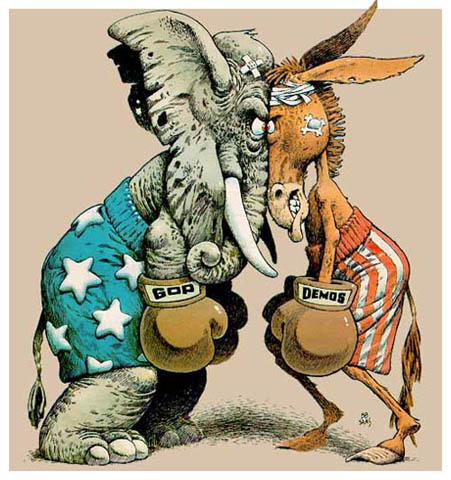
"A wise and frugal government which shall restrain men
from injuring one another, which shall leave them otherwise free to regulate their own pursuits of industry and improvement, and shall not take from the mouth of labor the bread it has earned. This is the sum of good government."
(Thomas Jefferson)


Showing posts with label S and P Downgrade. Show all posts

Monday, August 8, 2011

National Review: Obama Makes History (of Our AAA Credit)


The truth about Obama and the Democrats in one short paragraph.  Their lack of budget for over two years has caught up with them even though they try to deflect to it is always someone else's fault.  This time the lack of a budget lies direct at the feet of Obama and the Democrats who for two years had complete control of the Federal Government and for two years before that had total control of Congress.  That's why the FAA has been part of continuing resolutions since the fall of 2007 -- no budgets from the Democrats.  Are they afraid to do a budget and we can see how much their boondoggles are really costing the US taxpayer which led to this huge deficit increase under the Democrats?   This last time Obama submitted a budget and then took it back but he has a plan he keeps touting that no one sees.  Guess his could wave his magic wand and make one appear.

This editorial nails Obama and the Democrats for the downgrade.  Still boggled that Obama surrogates are blaming the Tea Party who wants more cuts not less.  There are a lot of words that come to mind the first one being 'stupid' and the second one being 'dumb' which describes how the Obama Administration has handled the economy.  All of a sudden Obama holds a cabinet meeting this morning -- not impressed when he hardly holds any cabinet meetings.
Obama Makes History (of Our AAA Credit)
The Obama administration and congressional Democrats are betting their political futures on the hope that the American electorate is ignorant and forgetful, and hence the memo has gone out to functionaries hither and yon, from David Axelrod to John Kerry: This is to be called the “tea-party downgrade.” That this is said with straight faces bespeaks either an unshakable contempt for the mind of the American voter or an as-yet unplumbed capacity for Democratic self-delusion. 
Let us revisit the facts. The original debt-ceiling deal put forward by the Democrats totaled $0.00 in debt reduction. This would have fallen approximately $4 trillion short of the $4 trillion in debt reduction the credit-rating agencies suggested would constitute a “credible” step toward maintaining our AAA rating and avoiding a downgrade. This $0.00 program was the so-called “clean” debt-ceiling bill — the one that contained not a farthing of debt reduction. Bad as it was, Republicans agreed to give Democrats a vote on it. Some 82 Democrats and every Republican voted against it, and for good reason: Doing nothing at all is hardly a “credible” program. 
The Democrats have suggested that Republicans’ refusal to accede to tax hikes is the main reason Standard & Poor’s felt it necessary to issue a downgrade, the first in American history, last Friday evening. In their assessment of Standard & Poor’s reasoning, the Democrats are acutely at odds with Standard & Poor’s. The credit-rating agency did not call for tax hikes in its assessment: “Standard & Poor’s takes no position on the mix of spending and revenue measures that Congress and the Administration might conclude is appropriate for putting the U.S.’s finances on a sustainable footing.” No position on tax hikes. But S&P, along with the other credit-rating agencies, has long taken a position on one aspect of our fiscal troubles: entitlement reform. From S&P again: “The plan envisions only minor policy changes on Medicare and little change in other entitlements, the containment of which we and most other independent observers regard as key to long-term fiscal sustainability.” 
As anybody who has looked at our long-term deficit projections knows, entitlement spending is the major driver of our future deficits. With unfunded liabilities for Social Security and Medicare already running into trillions of dollars — many multiples of our GDP — it is implausible that taxes would be raised sufficiently to meet those obligations. Sustaining present spending levels over coming decades while maintaining current levels of debt would mean nearly doubling every federal tax: income, payroll, inheritance, excises, etc. To repeat: That’s to maintain current debt levels, not to reduce them. Even if the political will existed to inflict such tax increases on the American people, doing so would prove economically ruinous. Entitlement reform, then — not taxes, not President Obama’s fictitious “balanced approach” — is rightly understood, as S&P argues, as the “key to long-term fiscal sustainability.” Tea-party leaders, far from being a barrier to entitlement reform, have demanded it. 
Excerpt:  National Review Editorial
Looking at the Bloomberg scroll for stocks is showing all red arrow pointing down.  Have been watching for three minutes and have not seen one green arrow yet for stocks.  Crude Oil is down to $81.71 so may there is a silver lining yet for gas prices but not holding my breath.  Most commodities are down except for  gold, and silver.   How low will the markets go this week?  Right now the so-called 'experts' from the Ivy League Business schools are all over the place.  Treasuries are up today if you count 5 cents while stocks are down especially in the financial sectors.  In another 35 minutes, the markets will close and then all the talking heads can start in with the spin for the evening.  Wonder who gets the blame tonight?

Sunday, August 7, 2011

Recession Fears increase with S&P Downgrade of US Credit

There is something about the S&P downgrade of the US Credit rating which makes us wonder what is the real story behind this and who is pulling the strings as S&P pushes for the end of the Bush Tax Cuts which should be a red flag to anyone.  Is there a conflict of interest with S&P?  They are not asking for the Government to spend less and if you read between the lines, they want the Government to spend more and get the revenue from allowing the Bush Tax Cuts to expire it looks like across the board.  The S&P comments in their press release look like they come straight of the DNC.
S&P laid blame for its decision to assign the AA+ rating directly on the political process in Washington. Even though lawmakers reached a decision on Aug. 2 to raise the government's debt ceiling and avoid a potentially disastrous default, the deficit-reduction package that accompanied the deal won't sufficiently improve the government's fiscal health in the coming years, S&P said in a release Friday. A factor in that projection, S&P said, is that Republicans seem unwilling to allow the Bush-era tax cuts to expire. 
From across the Atlantic comes these questions which frankly most should be asked  of S&P by members of Congress.  Hearings need to held into what went into this downgrade since the S&P release was so much like Democrat Talking Point paper.  These are legitimate questions that need answers but why once again is our media like crickets?

10 Questions About S&P Downgrade
By Barry Ritholtz - August 6th, 2011, 7:34AM
The downgrade from TripleAAA to AA+ by Standard & Poors raises many questions. Here is my list of most important issues the downgrade raises:
1. The change in trajectory of US debt was in service of Banks: It began with TARP, and continued with every other bailout/stimulus/economic plan. What was S&P’s role in creating that crisis? 
2. How will non-US investors (Private and Central Banks) view the downgrade? 
3. What is S&P’s methodology of rating sovereigns beyond Probability of Default? How does this differ from other rating agencies? 
4. What does the downgrade do to US currency — is that the true impact of the credit downgrade? 
5. Will borrowing costs likely increase for the US? What about consumers? 
6. Will the downgrade of US spill over to other agencies, states, municipalities? 
7. Will private sector holders of US Treasuries — insurers, pension, foundations, etc. — be downgraded as well? 
8. Why did the rating agency not wait until the special committee / debt ceiling deal was completed later this year? 
9. The Rating Agencies were downgraded by Dodd-Frank, with all regulatory and legal references to be removed. Was S&P’s move retaliatory? 
10. How will US markets open on Monday in response to the downgrade?
Thanks to Josh Rosner, Scott Frew, and other anonymous participants
Why is it that every time we have something to do with the economy, banking, etc., that it always goes back to the Dodd-Frank bill.  Even today, do most of us have a clue what is in that bill that was used to pay back their big donors?  That may be right up there with Obamacare for being a bad bill.

Going to MIT instead of the Ivy League for comments made me stop and notice this article on AOL this afternoon.  How many Ivy League guru's who helped get us in this mess are going to talk about stuffing money in your mattress where it would be safe?  Bet there are none!  

Word is coming out that Geithner has agreed to stay on as Treasury Secretary which we do not find is good news.  One more reason to send Obama and his whole Administration to the Unemployment Line on 6 November 2011.

Alden@huffingtonpost.com 
U.S. Credit Downgrade By S&P Darkens Economic Outlook, Stokes Recession Fears 
First Posted: 8/6/11 03:56 PM ET Updated: 8/6/11 04:40 PM ET NEW YORK --
With the United States government now shorn of its top credit rating by Standard & Poor's, experts are increasingly worried that the American economy is headed back into recession, while Europe appears vulnerable to another shock. 
The announcement that the rating agency had reduced the U.S. government's AAA rating for the first time in history came after days of punishing declines in the stock market, and has now cast a shadow over economic prospects in the months ahead. A recent stream of indicators has provoked concern that the economy could be headed for another recession, with the growth rate slowing considerably, unemployment stubbornly elevated and the stock market swooning. Some experts say the downgrade could be the final trigger, making credit more expensive and sowing broad unease. 
"People will be pulling money out of equity markets, out of commodity markets, and putting it into cash -- essentially, stuffing money in your mattress," said Andrew Lo, a professor of finance at the MIT Sloan School of Management, in an interview Saturday. "This is the worst thing to have happened, given the weak economy we already have." 
"Some straw has to break the camel's back," he added. "This may be the straw." 
The psychological impact of the downgrade might cause stocks to fall Monday and could exacerbate the sovereign debt crisis in Europe, experts say. Over time, it could raise the interest rates on 10-year and 30-year Treasury debt, making it more expensive for the federal government to borrow money, further worsening the deficit. The downgrade could also push up the cost of loans that are tied to the Treasury rate, making it more expensive for Americans to get funds to buy a car or a house. 
The effects could reach Europe, where nations that share the euro currency are contending with a debt crisis that seems to deepen by the week. While S&P didn't announce plans to reduce the ratings of European countries following its U.S. Treasury downgrade, experts said European downgrades might be inevitable, to maintain consistency in the rating system. That in turn could spark a new round of panic. 
S&P's decision comes at a time of critical economic weakness, as the American economy seems increasingly vulnerable to another contraction just two years after the official end of the recession that began in December 2007. Gross domestic product grew at an annual rate of just 0.85 percent in the first half of the year, the government announced in July. Seen in relation to population growth, GDP actually shrank in the first three months of the year. 
After other data releases showed the manufacturing sector weakening and consumer spending drying up, the Dow Jones Industrial Average lost 513 points on Thursday, in the biggest one-day drop since the depths of the financial crisis. 
It remains unclear what the precise effects of S&P's downgrade will be, or when they might materialize. Some experts believe the global economy will be able to absorb the downgrade without much turmoil. But others, like Lo, take a more pessimistic view. 
(snip) 
Although interest rates on long-term U.S. Treasury debt might rise as a result of the downgrade, rates on short-term debt could fall, as investors throw money at safe-haven assets. The yields on Treasury bills, which have the shortest lifespans of the government's debt securities, could fall below zero, if investors turn to U.S. debt that is keeping its rating intact. 
Interest rate movement in bond markets, moreover, might be minimal at first. Investors' attitudes about the economy influence their demand for Treasury debt; with the outlook grim, investors have been fleeing from risk, eager to lend money to the U.S. government and happy to accept low compensation. Yields on 10-year Treasury notes neared 2.4 percent, a low not seen since last fall, as the Federal Reserve was beginning a second massive economic stimulus. 
But over the next few years, yields on a variety of investments that are influenced by the Treasury rate might rise, implying that a whole range of assets would be treated as riskier. 
"When there's more demand for credit, that's when we're likely to see a re-pricing of risk," Mark Vitner, a senior economist at Wells Fargo, said Saturday. "In the very near term, our borrowing costs are going down, due entirely to economic weakness."  
Excerpt:  Huffington Post AOL
No one knows for sure what will happen tomorrow but it could get really nasty or the markets could look at S&P as an anomaly as the other two credit rating agencies, Fitch and Moody's, left the United States credit rating at AAA. Moody's is also pushing that the deficit be tackled and gotten under control versus raising tax rates. Now we wait for the markets to open worldwide to see the fallout while world leaders have been working the phones:

World leaders race to head off Monday stock market turmoil

August 7, 2011

World leaders and finance chiefs raced Sunday to head off spiralling tension triggered by eurozone debt contagion and a US rating downgrade as the clock ticked on the opening of the markets Monday.

Officials from the Group of 20 and Group of 7 economies held emergency conference calls Sunday as leaders of major powers conferred by phone and European Central Bank (ECB) governors readied for talks before the opening of the New Zealand market, the first to trade in Asia.

No details emerged from the talks, with officials in European doggedly tight-lipped.

In a sign of a possible storm ahead, the Israeli market fell seven percent Sunday and Gulf markets tumbled on opening but later trimmed some losses as investors reacted to Standard & Poor’s unprecedented cut in the the US rating to AA+ from the top notch triple-A.

“Until the stock markets open (Monday) the extent of earthquake caused by the downgrade of the US. debt rating will not be known,” said Spain’s El Pais daily newspaper. “But everything points to a black Monday which may intensify the attacks on the euro.”

Excerpt: Read more a Vancouver Sun

Just turned on the Bloomberg Channel on Cox and they are reporting that France could be next in line to be downgraded from AAA to AA. Tomorrow is shaping up along with the rest of the month to not be good days for those in the stock market unless they have been smart traders.

Friday, August 5, 2011

Breaking News from NY Times: S&P Downgrades US Long Term Debt Rating

Thanks to Obama and the Democrats in the Senate who refused to allow more cuts, S&P has downgraded the United States for the first time.  Another first for the Obama regime who in two years of runaway spending got us into the mess.  Then he gets us into Libya where we are spending unknown sums of money a day on a Country that makes no difference to the US.

Maybe instead of heading to Chicago to celebrate his birthday and rake in campaign funds, he should have stayed in DC and tried to head this off instead of partying.  Personally think he could care less no matter what he has to say or he wouldn't have gone to Chicago with this being a possibility.  Why didn't he demand that Congress stay in session to find more cuts -- oh wait, Obama doesn't like cuts because he wants to tax and spend.

Breaking News Alert
The New York Times
Friday, August 5, 2011 -- 8:41 PM EDT
-----
U.S. Long-Term Debt Downgraded by Standard & Poor’s 
Standard & Poor’s removed the United States government from its list of risk-free borrowers on Friday night, citing concern about the rising burden of long-term federal debt. 
The ratings agency had threatened the downgrade if the government did not act to reduce the federal debt by at least $4 trillion over the next decade. Earlier this week, Congress instead passed a plan to reduce the debt by at least $2.1 trillion. 
Two other ratings agencies, Moody’s and Fitch, both have said that they have no immediate plan to downgrade the country’s credit rating, giving the government more time to make progress on debt reduction. The split verdict limits the impact of the S.&P. downgrade as many consequences would only be triggered by a reduction by at least two agencies. 
Read More: http://www.nytimes.com/?emc=na