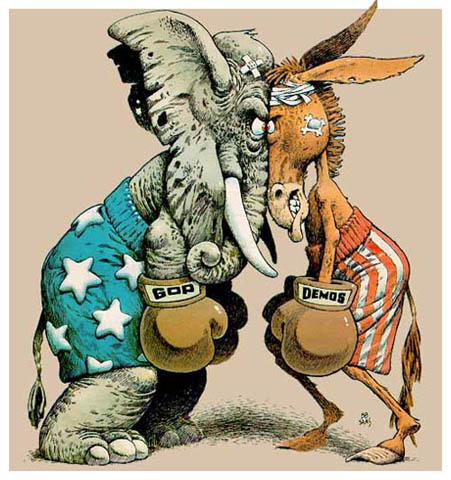
Now fast forward to 2007-08-09, when (1) Goldman Sachs bets its portfolio of Liar Loans against the short-traders then-coordinating the Obama campaign from within the Bush Treasury Dept, (2) sabotages the McCain campaign from within the Bush Treasury Dept, (3) hoodwinks George Bush into signing the TARP, (4) receives tens of billions of dollars stolen from the American taxpayer, (5) that they launder through AIG, (6) emerges from the collapse of the markets as the dominant force in NYSE program trading, and, (7) transforms $tens of billions of dollars [stolen from the American taxpayer] into record bonus payouts in the middle of the worst economic crisis since the Great Depression.
GOLDMAN BIG DEFENDS $12.9B PAID BY AIG By KAJA WHITEHOUSE, NY POST, March 21, 2009
Despite catching flack for having accepted $12.9 billion in taxpayer funds as payment for bets it made with beleaguered insurance giant American International Group, officials at Goldman Sachs were unapologetic, saying the payday was strictly business and aboveboard.
"We don't think we did anything wrong," Goldman's Chief Financial Officer David Viniar said in a conference call with reporters. "We had commercial terms. It is our responsibility to our shareholders to make sure that we are protecting ourselves. That's why we enter into these contracts."
Goldman set up the call to "clarify certain misperceptions in the press" around the bank's vulnerability to an AIG collapse. The Wall Street bank was largely successful in soothing those concerns, as Viniar explained how, despite a $20 billion derivative exposure to AIG as early as September, Goldman had set things up so that it could walk away largely unscathed had AIG gone bust.
Since July 2007, Goldman Sachs has spent around $100 million hedging against the risk of default in its AIG derivatives, said Goldman spokesman Lucas van Praag. But in soothing concerns over its exposure to AIG, Goldman officials opened another can of worms namely, why the firm was made whole on its bets, given AIG's troubled financial health and given that Goldman was so well-protected against default.
AIG has come under fire amid revelations that $90 billion of the government funds it received were funneled to its trading counterparties, whose contracts were largely bought out at face value. Goldman was the largest single beneficiary of the funds.
"I think the question is why did the Treasury not demand that Goldman Sachs and AIG negotiate down the collateral agreements on CDS?" said James Kaufman, a former Wall Street banker with Lazard Freres, referring to derivatives known as credit-default swaps. "If we had taken a discount, then we would have taken a loss to Goldman Sachs, and, frankly, as I'm sure you know, we also have taxpayer money at Goldman Sachs," Viniar said. Goldman got $10 billion as part of the Troubled Asset Relief Program.
Viniar also downplayed the notion that Goldman Sachs CEO Lloyd Blankfein had the ear of then-Treasury Secretary Hank Paulson, who was Blankfein's predecessor at Goldman.
Even before AIG became a government-owned enterprise, Goldman had already persuaded the company to pay it $7.5 billion in cash collateral as a result of the waning value of the assets tied to its derivative contracts.
After AIG was bailed out, Goldman received another $2.5 billion in cash collateral, plus $5.6 billion in payments made to unwind its contracts with AIG. Goldman said its remaining derivative exposure to AIG sits at around $7 billion, to which it's received $4.4 billion in collateral.
SOURCE: http://www.nypost.com/seven/03212009/business/goldman_big_defends_12_9b_paid_by_aig_160547.htm
Showing posts with label mortgage. Show all posts
Showing posts with label mortgage. Show all posts
Sunday, September 27, 2009


Subprime Lending Crises including Barack Obama's Involvement in the 90's (Part 2 - MERS, Kansas Supreme Court Ruling)
WAKING UP TO DISCOVER THE MORTGAGE MARKET WAS A GIANT CRIMINAL ENTERPRISE!
Matt Taibbi; Global Research.ca
9-22-09 Mike Taibbi
A landmark ruling in a recent Kansas Supreme Court case may have given millions of distressed homeowners the legal wedge they need to avoid foreclosure. In Landmark National Bank v. Kesler, 2009 Kan. LEXIS 834, the Kansas Supreme Court held that a nominee company called MERS has no right or standing to bring an action for foreclosure. MERS is an acronym for Mortgage Electronic Registration Systems, a private company that registers mortgages electronically and tracks changes in ownership. The significance of the holding is that if MERS has no standing to foreclose, then nobody has standing to foreclose – on 60 million mortgages. That is the number of American mortgages currently reported to be held by MERS.
Over half of all new U.S. residential mortgage loans are registered with MERS and recorded in its name. Holdings of the Kansas Supreme Court are not binding on the rest of the country, but they are dicta of which other courts take note; and the reasoning behind the decision is sound.
via Landmark Decision: Massive Relief for Homeowners and Trouble for the Banks. [link below]
This is a potentially gigantic story. It seems that a court has ruled that about half of the mortgage market has been run as a criminal enterprise for years, which would invalidate any potential forelosure proceedings for about, oh, 60 million mortgages. The court ruled that the electronic transfer system used by the private company MERS — a clearing system for mortgages, similar to a depository, that is used for about half the mortgage market — is fundamentally unreliable, and any mortgage sold and/or transferred through MERS can’t be foreclosed upon, at least not in Kansas.
Coincidentally I’d been working on something related to this all day yesterday. All over the country, lawyers are contesting foreclosures because of similar chain-of-custody issues. I have some material about this coming out in my next Rolling Stone story, so I can’t get into this too much, but suffice to say the lenders and the banks were extremely sloppy about their paperwork (at best — there is a fraud angle as well) and jammed up the system with missing and/or mismarked mortgage notes. Since a sale isn’t legal unless there’s full transfer of the physical note, a lot of the sales of mortgage-backed securities were not entirely legal, since the actual notes were often not transferred.
Nothing like waking up in the morning and finding out a whole sector of the economy is completely screwed. Are these good times or what?
Although this particular case pertains to MERS, non-MERS mortgages were often even worse. Anyway I have more on this coming next week. Thanks again to Eric at MonkeyBusiness for the heads-up.
Must Read: http://www.globalresearch.ca/index.php?context=va&aid=15324
*****
The Potential Impact of 60 Million Fatally Flawed Mortgages
The banks arranging these mortgage-backed securities have typically served as trustees for the investors. When the trustees could not present timely written proof of ownership entitling them to foreclose, they would in the past file “lost-note affidavits” with the court; and judges usually let these foreclosures proceed without objection.
But in October 2007, an intrepid federal judge in Cleveland put a halt to the practice. U.S. District Court Judge Christopher Boyko ruled that Deutsche Bank had not filed the proper paperwork to establish its right to foreclose on fourteen homes it was suing to repossess as trustee. Judges in many other states then came out with similar rulings.
Following the Boyko decision, in December 2007 attorney Sean Olender suggested in an article in The San Francisco Chronicle that the real reason for the bailout schemes being proposed by then-Treasury Secretary Henry Paulson was not to keep strapped borrowers in their homes so much as to stave off a spate of lawsuits against the banks. Olender wrote:
“The sole goal of the [bailout schemes] is to prevent owners of mortgage-backed securities, many of them foreigners, from suing U.S. banks and forcing them to buy back worthless mortgage securities at face value – right now almost 10 times their market worth. The ticking time bomb in the U.S. banking system is not resetting subprime mortgage rates. The real problem is the contractual ability of investors in mortgage bonds to require banks to buy back the loans at face value if there was fraud in the origination process.
“. . . The catastrophic consequences of bond investors forcing originators to buy back loans at face value are beyond the current media discussion. The loans at issue dwarf the capital available at the largest U.S. banks combined, and investor lawsuits would raise stunning liability sufficient to cause even the largest U.S. banks to fail, resulting in massive taxpayer-funded bailouts of Fannie and Freddie, and even FDIC . . . .
“What would be prudent and logical is for the banks that sold this toxic waste to buy it back and for a lot of people to go to prison. If they knew about the fraud, they should have to buy the bonds back.”
Needless to say, however, the banks did not buy back their toxic waste, and no bank officials went to jail. As Olender predicted, in the fall of 2008, massive taxpayer-funded bailouts of Fannie and Freddie were pushed through by Henry Paulson, whose former firm Goldman Sachs was an active player in creating CDOs when he was at its helm as CEO.
Paulson also hastily engineered the $85 billion bailout of insurer American International Group (AIG), a major counterparty to Goldmans’ massive holdings of CDOs. The insolvency of AIG was a huge crisis for Goldman, a principal beneficiary of the AIG bailout.
In a December 2007 New York Times article titled “The Long and Short of It at Goldman Sachs,” Ben Stein wrote:
“For decades now, . . . I have been receiving letters [warning] me about the dangers of a secret government running the world . . . . [T]he closest I have recently seen to such a world-running body would have to be a certain large investment bank, whose alums are routinely Treasury secretaries, high advisers to presidents, and occasionally a governor or United States senator.”
The pirates seem to have captured the ship, and until now there has been no one to stop them. But 60 million mortgages with fatal defects in title could give aggrieved homeowners and securities holders the crowbar they need to exert some serious leverage on Congress – serious enough perhaps even to pry the legislature loose from the powerful banking lobbies that now hold it in thrall.
http://www.globalresearch.ca/index.php?context=va&aid=15324
Here’s a link to the Court’s decision: http://www.kscourts.org/Cases-and-Opinions/opinions/supct/2009/20090828/98489.htm .
Matt Taibbi; Global Research.ca
9-22-09 Mike Taibbi
A landmark ruling in a recent Kansas Supreme Court case may have given millions of distressed homeowners the legal wedge they need to avoid foreclosure. In Landmark National Bank v. Kesler, 2009 Kan. LEXIS 834, the Kansas Supreme Court held that a nominee company called MERS has no right or standing to bring an action for foreclosure. MERS is an acronym for Mortgage Electronic Registration Systems, a private company that registers mortgages electronically and tracks changes in ownership. The significance of the holding is that if MERS has no standing to foreclose, then nobody has standing to foreclose – on 60 million mortgages. That is the number of American mortgages currently reported to be held by MERS.
Over half of all new U.S. residential mortgage loans are registered with MERS and recorded in its name. Holdings of the Kansas Supreme Court are not binding on the rest of the country, but they are dicta of which other courts take note; and the reasoning behind the decision is sound.
via Landmark Decision: Massive Relief for Homeowners and Trouble for the Banks. [link below]
This is a potentially gigantic story. It seems that a court has ruled that about half of the mortgage market has been run as a criminal enterprise for years, which would invalidate any potential forelosure proceedings for about, oh, 60 million mortgages. The court ruled that the electronic transfer system used by the private company MERS — a clearing system for mortgages, similar to a depository, that is used for about half the mortgage market — is fundamentally unreliable, and any mortgage sold and/or transferred through MERS can’t be foreclosed upon, at least not in Kansas.
Coincidentally I’d been working on something related to this all day yesterday. All over the country, lawyers are contesting foreclosures because of similar chain-of-custody issues. I have some material about this coming out in my next Rolling Stone story, so I can’t get into this too much, but suffice to say the lenders and the banks were extremely sloppy about their paperwork (at best — there is a fraud angle as well) and jammed up the system with missing and/or mismarked mortgage notes. Since a sale isn’t legal unless there’s full transfer of the physical note, a lot of the sales of mortgage-backed securities were not entirely legal, since the actual notes were often not transferred.
Nothing like waking up in the morning and finding out a whole sector of the economy is completely screwed. Are these good times or what?
Although this particular case pertains to MERS, non-MERS mortgages were often even worse. Anyway I have more on this coming next week. Thanks again to Eric at MonkeyBusiness for the heads-up.
Must Read: http://www.globalresearch.ca/index.php?context=va&aid=15324
*****
The Potential Impact of 60 Million Fatally Flawed Mortgages
The banks arranging these mortgage-backed securities have typically served as trustees for the investors. When the trustees could not present timely written proof of ownership entitling them to foreclose, they would in the past file “lost-note affidavits” with the court; and judges usually let these foreclosures proceed without objection.
But in October 2007, an intrepid federal judge in Cleveland put a halt to the practice. U.S. District Court Judge Christopher Boyko ruled that Deutsche Bank had not filed the proper paperwork to establish its right to foreclose on fourteen homes it was suing to repossess as trustee. Judges in many other states then came out with similar rulings.
Following the Boyko decision, in December 2007 attorney Sean Olender suggested in an article in The San Francisco Chronicle that the real reason for the bailout schemes being proposed by then-Treasury Secretary Henry Paulson was not to keep strapped borrowers in their homes so much as to stave off a spate of lawsuits against the banks. Olender wrote:
“The sole goal of the [bailout schemes] is to prevent owners of mortgage-backed securities, many of them foreigners, from suing U.S. banks and forcing them to buy back worthless mortgage securities at face value – right now almost 10 times their market worth. The ticking time bomb in the U.S. banking system is not resetting subprime mortgage rates. The real problem is the contractual ability of investors in mortgage bonds to require banks to buy back the loans at face value if there was fraud in the origination process.
“. . . The catastrophic consequences of bond investors forcing originators to buy back loans at face value are beyond the current media discussion. The loans at issue dwarf the capital available at the largest U.S. banks combined, and investor lawsuits would raise stunning liability sufficient to cause even the largest U.S. banks to fail, resulting in massive taxpayer-funded bailouts of Fannie and Freddie, and even FDIC . . . .
“What would be prudent and logical is for the banks that sold this toxic waste to buy it back and for a lot of people to go to prison. If they knew about the fraud, they should have to buy the bonds back.”
Needless to say, however, the banks did not buy back their toxic waste, and no bank officials went to jail. As Olender predicted, in the fall of 2008, massive taxpayer-funded bailouts of Fannie and Freddie were pushed through by Henry Paulson, whose former firm Goldman Sachs was an active player in creating CDOs when he was at its helm as CEO.
Paulson also hastily engineered the $85 billion bailout of insurer American International Group (AIG), a major counterparty to Goldmans’ massive holdings of CDOs. The insolvency of AIG was a huge crisis for Goldman, a principal beneficiary of the AIG bailout.
In a December 2007 New York Times article titled “The Long and Short of It at Goldman Sachs,” Ben Stein wrote:
“For decades now, . . . I have been receiving letters [warning] me about the dangers of a secret government running the world . . . . [T]he closest I have recently seen to such a world-running body would have to be a certain large investment bank, whose alums are routinely Treasury secretaries, high advisers to presidents, and occasionally a governor or United States senator.”
The pirates seem to have captured the ship, and until now there has been no one to stop them. But 60 million mortgages with fatal defects in title could give aggrieved homeowners and securities holders the crowbar they need to exert some serious leverage on Congress – serious enough perhaps even to pry the legislature loose from the powerful banking lobbies that now hold it in thrall.
http://www.globalresearch.ca/index.php?context=va&aid=15324
Here’s a link to the Court’s decision: http://www.kscourts.org/Cases-and-Opinions/opinions/supct/2009/20090828/98489.htm .
Subscribe to:
Posts (Atom)

 Raw Story
 Posts
Posts